MVP Hackathon for a Social Networking App
Find compatible run buddies on-the-go and build your running community
Timeline
2024, 10 weeks
Responsibilities:
UX Research, Prototyping, Visual Design
Project
Mobile App Design
Challenge
Create a basic version of the app in just 48 hours.
Solution
Feature Prioritization: The team focused on essential features like user registration, profile creation, and posting text updates. Fancy extras were put aside for now.
Rapid Prototyping: Developers used low-fidelity wireframes and existing UI templates to quickly build the app's front-end, saving time on design.
Leveraged Third-party Tools: Instead of building everything from scratch, they integrated existing services for user authentication and cloud storage.
User Testing: Regular testing and feedback sessions with potential users helped in identifying crucial improvements.
Results:
Delivered a functional MVP in just 48 hours.
Minimal resources were used, saving time and money.
Gathered valuable user feedback for future iterations.
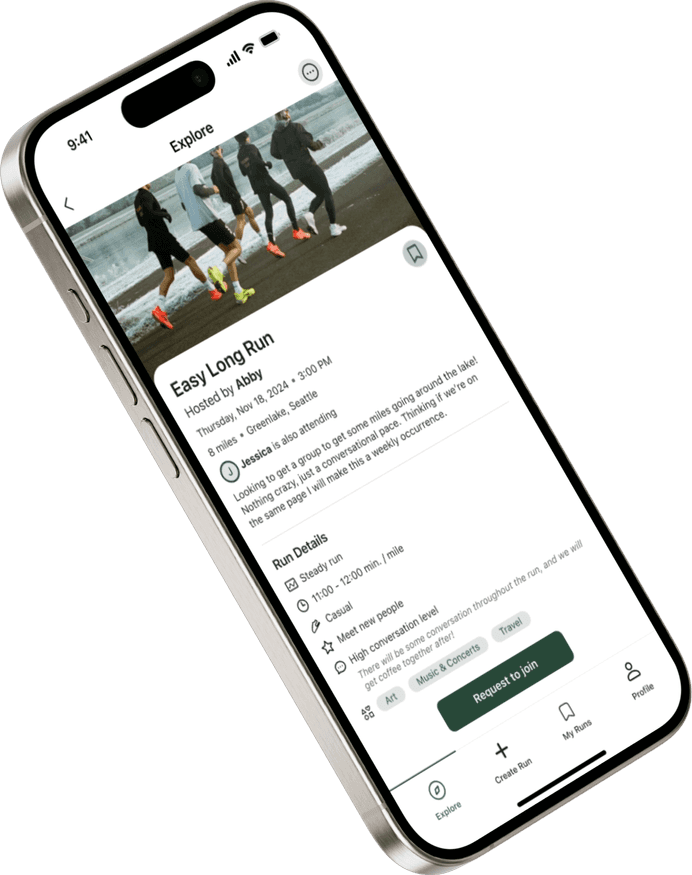
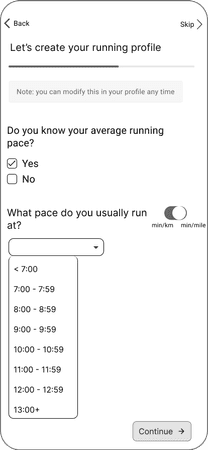
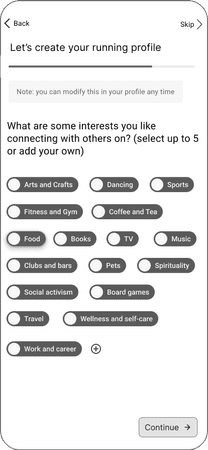
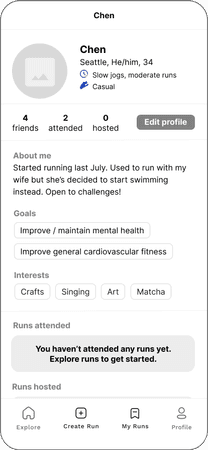
Specify your running preferences and goals to build your profile and tell other runners about yourself
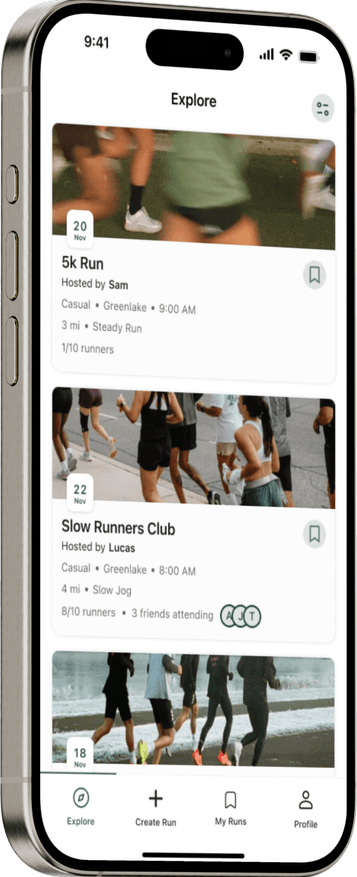
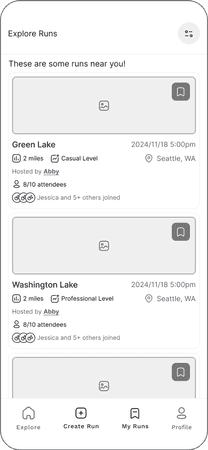
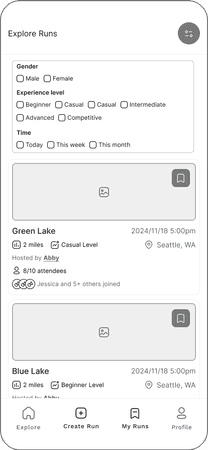
Find runs organized by people near you to join and filter based on your personal preferences and needs
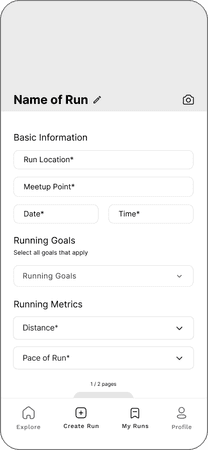
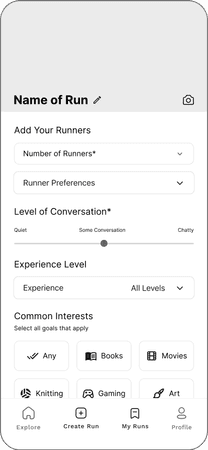
Create your own runs and control details such as location, pace, distance, and more to build your running community
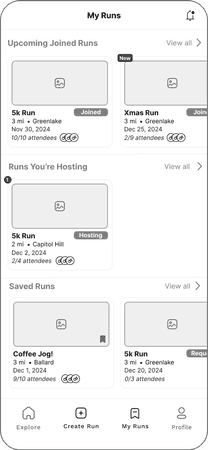
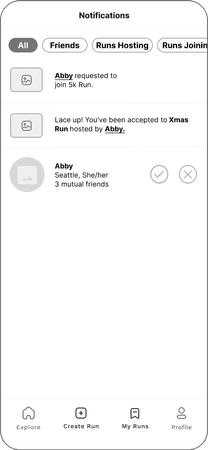
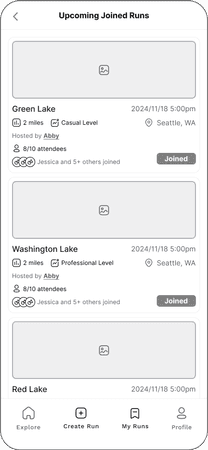
View your runs to keep track of notifications and runs you are joining, hosting, and have saved
Research
In our competitive analysis, it quickly became clear that current popular solutions are not dedicated to the social aspects of running. Some clear themes emerged in our user research conducted via surveys and interviews:
Both running and interpersonal factors matter for compatible running partners
Logistical and social barriers like pace and social anxiety are significant challenges
Runners prefer to have connections and feel familiar with their running buddies
Key Insight: Narrowing down target users
We quickly realized performance-oriented runners were already supported by a plethora of existing solutions on the market. We decided to focus on runners oriented towards social runners and the non-performance aspects of running such as socializing, de-stressing, and exploring.
Ideation & Prototype
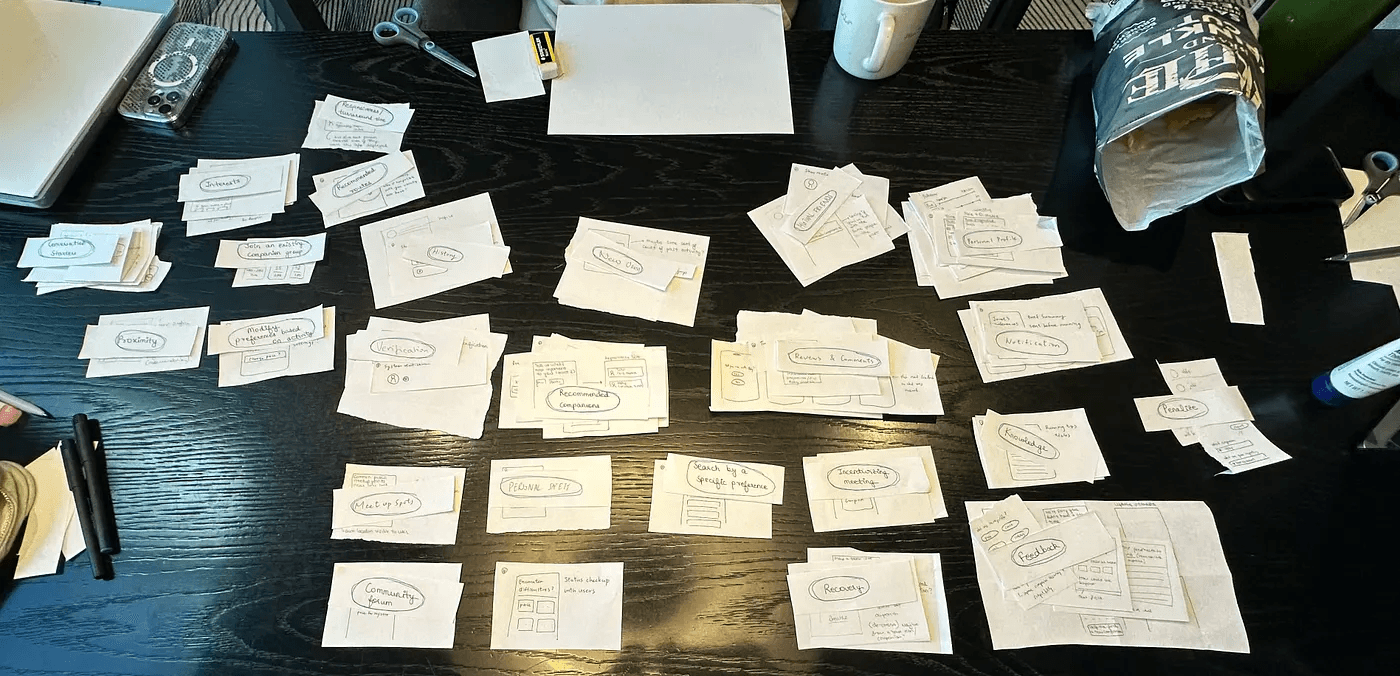
After thoroughly exploring ideas through sketches and critiquing, we prioritized for a minimum viable product: Recommended Runs. We shifted our designs to recommending runs rather than individual runners to focus on compatibilities that are important for running, as well as to enhance feelings of safety and comfort by allowing group runs.
Onboarding
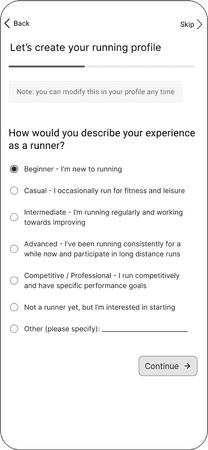
Specify running and interpersonal preferences such as pace and interests
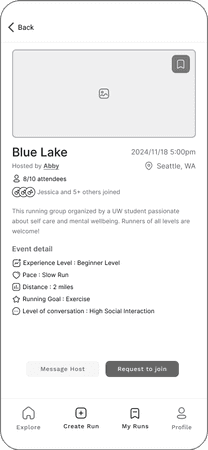
Explore runs
Discover and join runs happening nearby with the option to filter based on preferences
Create Runs
Create a run to specify details like location, pace, distance, etc., and let others join you
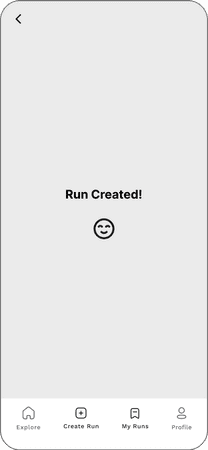
My Runs
Keep track of upcoming runs, saved runs, and related notifications all in one place
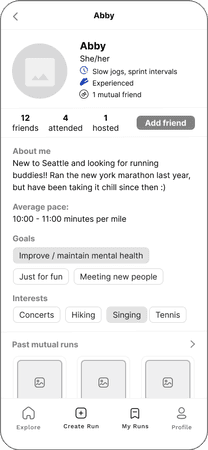
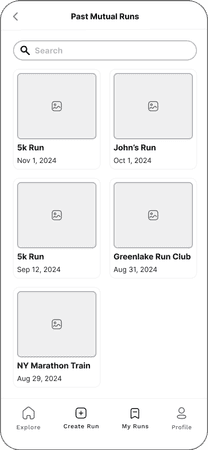
Profiles
Tell the running community about yourself and connect with your running companions
Testing & Feedback
We conducted usability tests to gather feedback on our initial prototypes. Additionally, for exploring and creating runs, we A/B tested a few variations for specific areas of the screen, gathering user feedback on each. Some key changes from testing included:
Feedback
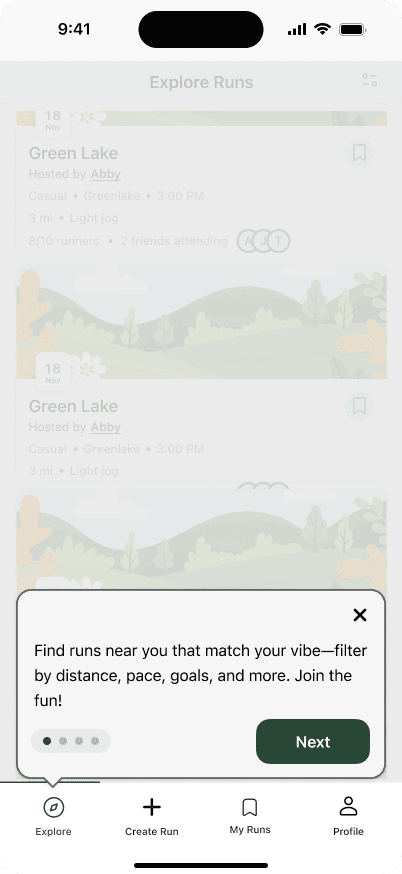
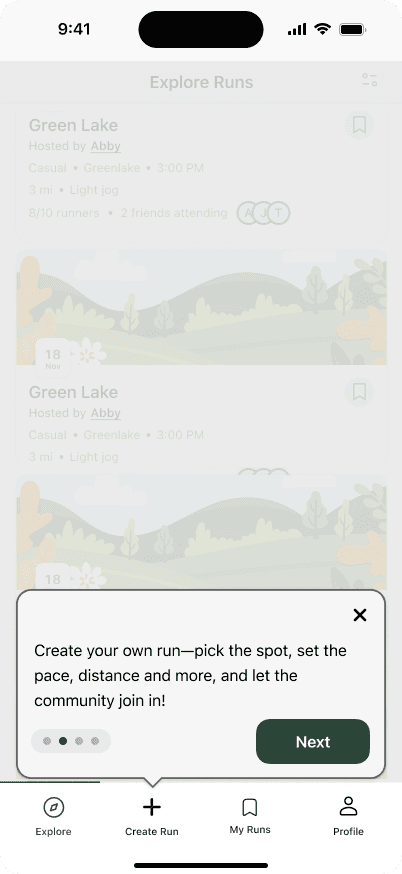
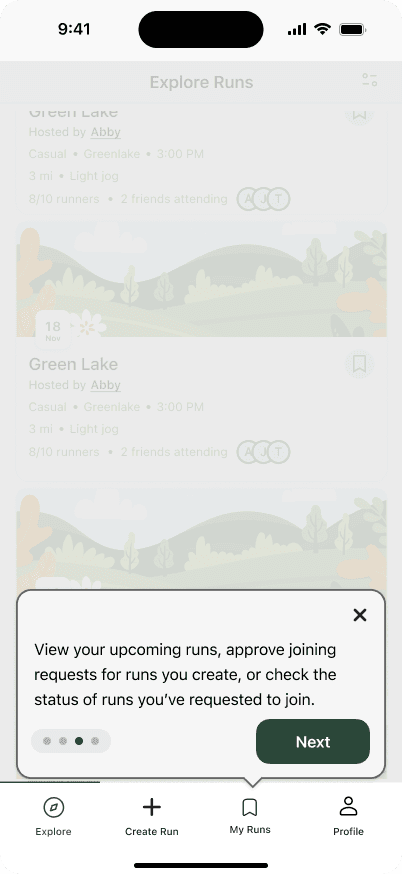
Curiosity and confusion about solution functionality and terminology such as "My Runs"
Iteration
Add initial walk-through tutorial to introduce users to the app's key pages and functionality
Mid-fidelity walk-through tutorial pages
Feedback
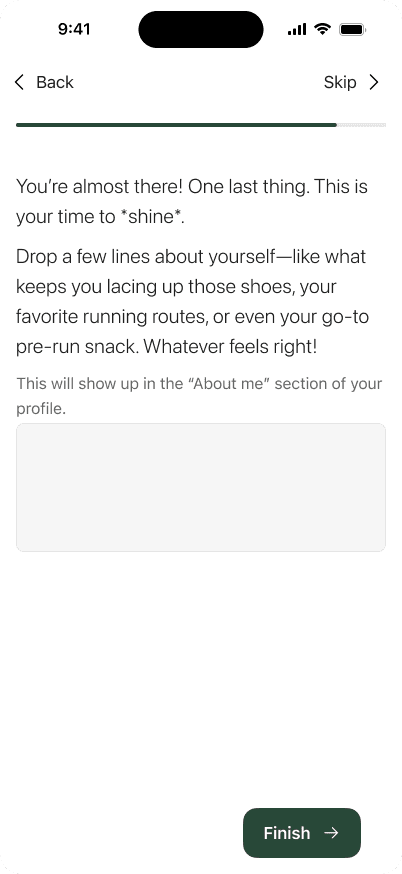
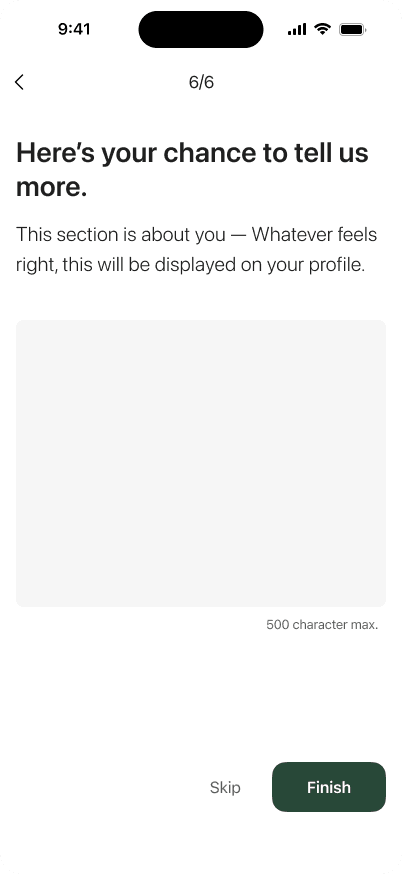
Text-heavy processes such as onboarding and creating runs feel laborious and time-consuming
Iteration
Simplify and reduce text during onboarding and create runs to minimize effort required
Before and after "About me" onboarding page (mid- to high-fidelity)

Feedback
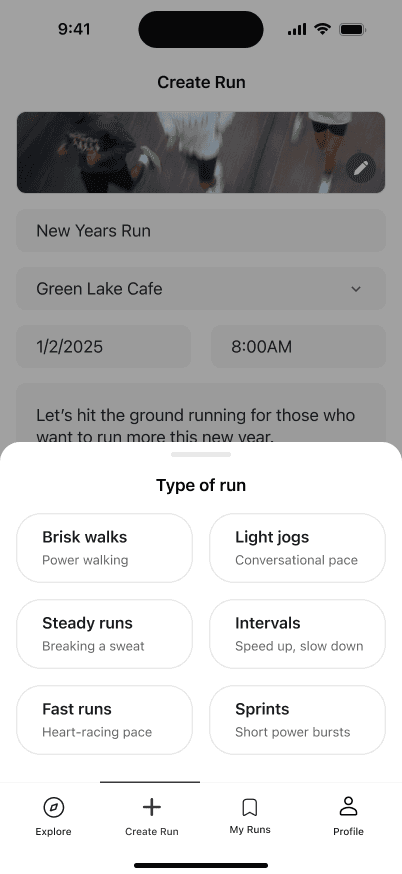
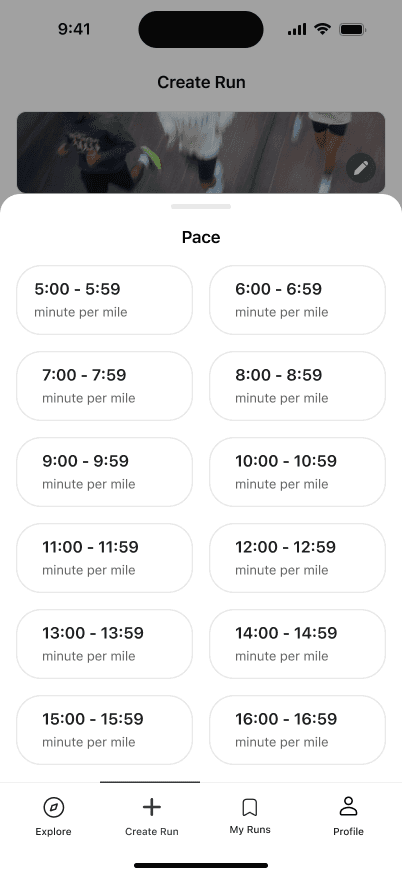
Some runners want to ensure compatibility beyond the type of run by specifying a pace.
Iteration
Allow runners to specify time by run type, pace timing, or both.
Create run: "Type of run" "pace" selection pages added
Iterations & Measuring Success
As we continued to test on users, key areas for future iterations emerged:
In-app Feedback
Allow runners to easily provide constructive input about their running experiences and the app itself
Conversation Starters
Provide runners with prompts based on commonalities to break the ice before runs
Some metrics that will be important to measure include:
Challenge
Create a basic version of the app in just 48 hours.
Solution
Feature Prioritization: The team focused on essential features like user registration, profile creation, and posting text updates. Fancy extras were put aside for now.
Rapid Prototyping: Developers used low-fidelity wireframes and existing UI templates to quickly build the app's front-end, saving time on design.
Leveraged Third-party Tools: Instead of building everything from scratch, they integrated existing services for user authentication and cloud storage.
User Testing: Regular testing and feedback sessions with potential users helped in identifying crucial improvements.
Results:
Delivered a functional MVP in just 48 hours.
Minimal resources were used, saving time and money.
Gathered valuable user feedback for future iterations.